

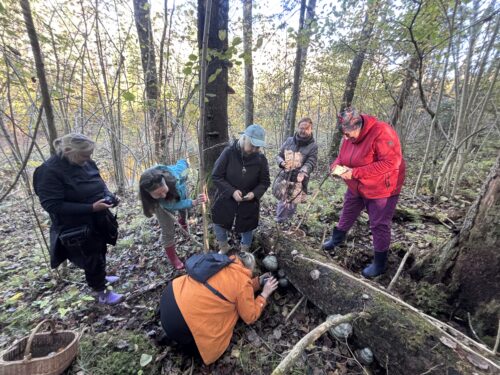
On 18 October 2026, the Latvian Mycological Society held an excursion in the “Salacas ieleja” (Salaca Valley) Nature Park. Its…

The initiator of research and water quality improvement on the Salaca is the fishing club “Salackrasti”, to which Limbaži Municipality has also entrusted the management of the river. As the club’s chairman Atis Apelis explained, one of the aims of the project is to obtain a nature conservation plan for the river.
“The most important thing for us is that at the moment we can only attract one single source of funding, the Fish Fund. We have carried out two Fish Fund projects so far, but the amounts are so small, and we cannot use other funding because we do not have a valid, existing nature conservation plan,” said Apelis.
The fishing club “Salackrasti” has already cleared overgrowth from the river and its tributaries, and this work will continue this year, but, as Apelis explained, it will now be done under the supervision of scientists.
“In this project we will do it a little differently, in a much more nature-friendly way than before: experts will study the work we have done and make recommendations, and our work will be carried out under their supervision. There is no single model for how to clear rapids correctly. We, the “Salackrasti” association, clear them the way we think is right, and another association on the Gauja or the Venta clears them the way they think is right. There is no single model of what is correct, so in the third year of the project we will also transfer our practice to the Gauja and the Venta,” said the chairman of the fishing club.
In total, rapids on an area of 20 hectares are to be cleared over five years.
The Nature Conservation Agency, the Latvian Environment, Geology and Meteorology Centre and the institutes “BIOR” and “Silava” are also involved in the project to improve the water quality of the Salaca and its tributaries.
“Our project budget over five years and for five partners together is just under 6 million euros, or 5,754,000,” said project manager Edijs Leoke. Over the five years, a set of measures will be carried out with the main idea of gaining experience in how to manage rivers and using that experience on other rivers as well.
“We have to monitor every activity so that we can prove improvements scientifically, or show how our work has affected the environment and nature. Knowledge transfer is also planned, with a series of seminars and workshops. We have to draw up proposals for changes to legislation in areas related to rapids restoration and riparian forest management, as well as the harmonisation of the Water Framework Directive and the Habitats Directive, and we are also drawing up a nature conservation plan,” said Leoke.
At the meeting with residents in Mazsalaca, however, concerns were also raised that such a large sum, almost six million euros, should rather be invested in practical work, for example in controlling hogweed.
All the rivers there are completely overgrown! The Salaca there is all hogweed, what are you going to do about it? It is all catastrophic!
This project is certainly not a pot of gold… The “LIFE” programme is not just about simple practical work in nature.
However, the project covers only the section of the Salaca from Staicele to its mouth in the Gulf of Riga, while the biggest water quality problems are at its source in Lake Burtnieks. That is why, in the view of Līga Zvirbule, head of the Natural Resources Department of Valmiera Municipality, the project is unlikely to improve water quality as a whole.
“What is absolutely clear is that the quality of surface water in a river starts in the upper reaches, across the whole catchment area. In other words, you cannot solve surface water quality problems at the river mouth; you can mitigate some consequences, but surface water quality is affected by the activities taking place in the catchment and by human activity,” said Zvirbule.
But the fishing club “Salackrasti” also invites everyone to join in on 11 May and take part in a clean-up to collect litter on the banks of the Salaca.
Author: LSM