

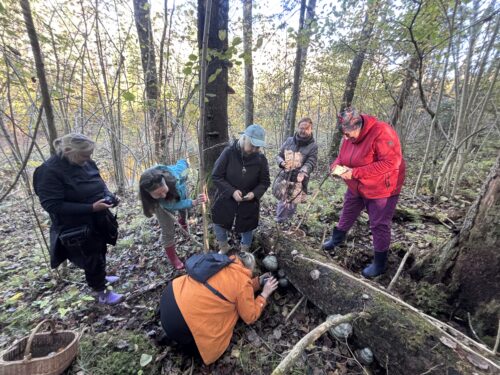
On 18 October 2026, the Latvian Mycological Society held an excursion in the “Salacas ieleja” (Salaca Valley) Nature Park. Its…

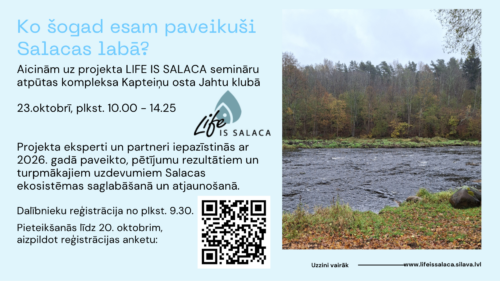
A year has now passed since the large-scale LIFE IS SALACA project started in Latvia. The project’s goals are ambitious, and no single organisation could achieve them alone, so five organisations have joined forces. The first year of the project has been completed successfully, and a great deal has been achieved!
Data collection and analysis
The first year was dedicated to a detailed study of the Salaca, its tributaries and the riparian forests in order to obtain various data. At the beginning of summer, project experts from the Nature Conservation Agency (NCA), the Institute of Food Safety, Animal Health and Environment “BIOR” (BIOR) and the state limited liability company “Latvian Environment, Geology and Meteorology Centre” (LEGMC) spent 10 days on the river carrying out extensive field research on the Salaca and its tributaries. In total, the experts walked and boated along about 100 km of rivers. This is the first time monitoring of this size and scale has taken place in the Salaca basin, and a new method for assessing ecological and habitat quality was developed for it.
In the first year of the project, a new approach to assessing the health of rivers was also developed, based on a common methodology for the Water Framework Directive and the Habitats Directive. In the course of developing the methodology, a new river inventory protocol was created, along with detailed instructions for filling it in. The new, harmonised protocol combines the requirements of both directives – the Water Framework Directive and the Habitats Directive. Although both directives share a common goal – to achieve good quality in freshwater ecosystems – their approaches to achieving it differ. This is also one of the project’s tasks: to harmonise, or align, the Water Framework Directive and the Habitats Directive.
Rapids restoration works
Based on the results of the fieldwork and the experts’ recommendations, the association “Fishing Club “Salackrasti”” carried out the first restoration works on rapids habitats and salmon spawning grounds this summer in several river sections covering a total of 6.34 ha – 1.22 ha upstream of the Korģe mouth, 0.58 ha in the section at “Atpūtas” and 4.63 ha at “Brūveļi”. The river sections where rapids will be restored in the coming years will be selected later, after the analysis of all the data collected in this summer’s field studies.
Riparian forests
The riparian forests along the Salaca and the small rivers flowing into it have changed considerably over the last 30–35 years. Within the LIFE IS SALACA project, the best management practice for these forests is being identified, based on an assessment of ecosystem services. Ecosystem services are what each of us can get from nature and the environment. We usually notice the most visible things, such as timber, mushrooms, berries and biodiversity. However, riparian forests provide many more services that we as a society receive, including genetic resources, pollination, landscape, clean water and air. By putting together qualitative and quantitative data on these ecosystem services, we want to make it possible to assess both the current and the future situation, that is, to understand which ecosystem services we receive now and which we will receive in the future if we choose a particular type of riparian forest management. Several demonstration areas are also planned, where the impact of a particular type of management on riparian forests can be seen.
One of the project partners, LEGMC, reports that, according to the river basin district management and flood risk management plans for 2021–2027, only 34% of Latvia’s river and lake water bodies are of good or high ecological quality. The main factors preventing good ecological status are excessive inputs of plant nutrients and the presence of hydromorphological alterations in rivers or on their banks. Properly carried out riparian forest management and rapids restoration are expected to improve the ecological quality of the Salaca and its tributaries. During the project, unique monitoring data will be obtained that will make it possible to determine the impact of the work on the river ecosystem.
Monitoring
The project also includes monitoring of ecological quality elements. A separate task of the project is to develop a common method for assessing the quality of freshwater habitats of EU importance and the status of individual ecological quality elements, and to test this method in the Salaca sub-basin. The results obtained with this method can later be used to prepare reports for the European Union’s Water Framework Directive and Habitats Directive. In the future, this will help reduce the overall cost of national monitoring. The project’s complicated name hides a simple explanation – improving the monitoring system. The monitoring results will be available free of charge on the websites of LIFE IS SALACA and the responsible partners.
Future plans
In the following summers (15 July – 15 September) until 2028, rapids restoration works will continue in various sections of the Salaca sub-basin. Demonstration areas showing examples of good practice will also be set up in riparian forests, with walking trails leading to them, so that anyone interested can follow how the forest develops after the management work and be inspired.
In 2026, work is planned to start on the nature conservation plan for Salacas ieleja, which will include the data obtained and results achieved during the project and will give guidance on possible and desirable measures for the development of the area.
A nature conservation plan is a long-term planning document whose task is to balance the interests of nature conservation, use of natural resources and regional development. It is a big challenge, as the plan is drawn up for 12–15 years, but it is also an opportunity to decide the future of the area. This cannot be done without the involvement of local residents, the municipality and other stakeholders, so we invite you to be active and take part in this important process. The nature conservation plan will make a big contribution to local communities.
An important part of the project is also sharing the knowledge and good practice created within LIFE IS SALACA with the public and experts in the field. This includes organising various seminars and clean-ups, preparing guidelines, and creating the interactive exhibition “On the banks and in the depths of the Salaca” at the nature education centre in Salacgrīva, which work will start on in 2026. The exhibition will present information about the Salaca River, its history and management, freshwater quality, and various species and habitats in popular-science language.
Although the project lasts five years, we hope that the municipalities and local landowners on whose land the project activities take place will be interested in and able to continue and maintain what has been started. All LIFE programme projects are aimed at sustainable action, so the involvement of local communities is very important and welcome.
The LIFE IS SALACA project, “Adaptation of Water Framework Directive and Habitats Directive harmonization and integrated actions for freshwater quality improvement in Salaca river sub catchment”, is implemented with financial support from the European Union’s LIFE programme and the State Digital Development Agency. It is carried out jointly by the Latvian State Forest Research Institute “Silava”, the Nature Conservation Agency, the association “Fishing Club “Salackrasti””, the Institute of Food Safety, Animal Health and Environment “BIOR” and the state limited liability company “Latvian Environment, Geology and Meteorology Centre”, with the aim of helping to achieve good water status in the rivers of the Salaca sub-basin.