

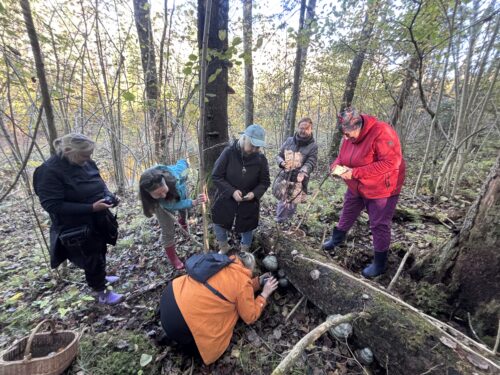
On 18 October 2026, the Latvian Mycological Society held an excursion in the “Salacas ieleja” (Salaca Valley) Nature Park. Its…

On 11 September, a field seminar – a demonstration of rapids restoration works – took place on the Salaca near the Vanagi farmstead. The work on the fourth most important salmon river in the Baltic Sea region was carried out by the association “Fishing Club Salackrasti” as part of the project “Adaptation of Water Framework Directive and Habitats Directive harmonization and integrated actions for freshwater quality improvement in Salaca river sub catchment” (LIFE IS SALACA).
Atis Apelis, board member of the association “Fishing Club “Salackrasti””, explained how the rapids are restored. “We restore the rapids on the Salaca with an excavator. We learned this method of restoring salmon spawning grounds in Sweden, and although at first it was not particularly recognised in Latvia, it is now considered good enough. In Latvia there is no clear guidance on how to clear rapids correctly – we work according to our own understanding. Time will tell whether we are going in the right direction,” said Atis Apelis.
This year, because of the high water level, the men of the fishing club could only start work on the Salaca on 22 August. To get the planned work done, they worked in two shifts, and four rapids with a total length of 1.5 kilometres have been restored. The thick grass turf (30–40 cm) was dug away with a tractor, exposing stones and pebbles – a substrate suitable for spawning salmon, sea trout, vimba and lampreys. The digging is done with a special bucket whose teeth, although made of extra-strong material, wear out within a week.
“This is the last place we are working this year, as the work has to be finished by 15 September. We still have to level the banks so that the landowners will be happy to see us again next year,” says Atis Apelis.
The rapids restoration works on the Salaca are followed by the Institute of Food Safety, Animal Health and Environment “BIOR”, whose scientists monitor the fish resources.
Kaspars Abersons, lead fish expert at BIOR, stressed: “This is the first year we have been following the work on the river, and monitoring was not particularly good this year because the water level was too high, but the conclusion is clear – there are young salmon in the restored rapids. We could not carry out the monitoring earlier than July, as the young salmon are still very small. We will continue monitoring next year and hope for better weather conditions. Although LIFE IS SALACA is not primarily a scientific project, monitoring is important – it helps us understand how fish resources recover.”
Mārcis Saklaurs, researcher at the Latvian State Forest Research Institute “Silava”, the lead partner of the LIFE IS SALACA project, also took part in the seminar and talked about the importance of riparian forests in improving the Salaca ecosystem. Highlighting their importance, he said: “The riparian forest protection zone set in Latvia is 50 metres, and in it owners may do nothing, or very little. If we do nothing, the forest becomes overmature, collapses and nutrients end up in the river. That is why the forest has to be managed – tended, with old trees replaced by young ones, thus maintaining the natural balance. The forest on the bank has to serve as a protection or buffer zone: water coming from agricultural, forestry or other land, from human pollution or from the air, should be “caught” in the riparian forest as it flows through the protection zone, so that it does not flow into the river and cause overgrowth, siltation and other harmful processes there.”
Over the years, the Salaca has gradually become overgrown, and it is getting harder for salmon to reach their spawning grounds. There are several causes – the Soviet-era legacy of farms on the riverbanks, today’s intensive agriculture and climate change. If we do nothing, the future looks bleak – the river will become overgrown, the number of naturally spawning salmon will decline, and in places it will no longer be possible to get through by boat.
The rapids restoration works on the Salaca and the targeted, sustainable and science-based management of riparian forests will improve the ecological quality of the waters and keep the Salaca a viable salmon river for future generations.
The project “LIFE IS SALACA”, “Adaptation of Water Framework Directive and Habitats Directive harmonization and integrated actions for freshwater quality improvement in Salaca river sub catchment”, is implemented with financial support from the European Union’s LIFE programme and the Ministry of Smart Administration and Regional Development. It is carried out jointly by the Latvian State Forest Research Institute “Silava”, the Nature Conservation Agency, the association “Fishing Club “Salackrasti””, the Institute of Food Safety, Animal Health and Environment “BIOR” and the state limited liability company “Latvian Environment, Geology and Meteorology Centre”, with the aim of helping to achieve good water status in the rivers of the Salaca sub-basin.