

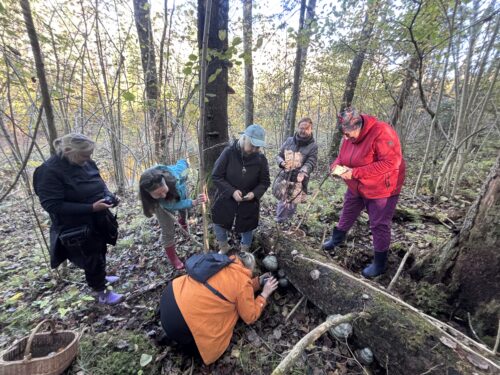
On 18 October 2026, the Latvian Mycological Society held an excursion in the “Salacas ieleja” (Salaca Valley) Nature Park. Its…

On Saturday, 5 October at 11:00, the Nature Conservation Agency invites you to take part in the hike “Riverbank hike along the Salaca”. During this educational event you will be able to see the marks left by wind and water in sandstone rocks, climb over large boulders lying in the bed of the Noriņupe, see century-old giant oaks and enjoy the magic of the deciduous forest.
What is river hiking and what is riverbank hiking? Are they different, and how?
There are no official definitions or specific explanations of these terms. It is generally accepted that riverbank hiking means walking along the banks of watercourses, while river hiking means moving along the bed of the watercourse. However, rivers are very diverse and changeable – some have a barely noticeable current and others strong rapids, some places are shallow and stony, others deep with sandy or muddy bottoms. Depending on the river, riverbank hiking sometimes includes crossing the river or partly walking in it, and river hiking also includes walking along the banks. That is why the two terms are hard to separate. Both are definitely forms of active outdoor recreation in which you enjoy Latvia’s natural values, as scenic rivers are always chosen for the routes.
From a nature conservation point of view, do these activities harm nature?
Rivers and their banks are sensitive ecosystems. They are often home to various rare and specially protected species, such as the thick-shelled river mussel, the river nerite and the river snail, and a special rarity is the freshwater pearl mussel, which is now found in only a few Latvian rivers. Young sea trout and crustaceans find shelter in the beds of fast-flowing rivers. The zone where water and land meet is very important for biodiversity – it is a place where many organisms shelter, migrate, live and feed. Here, aquatic insect larvae turn into flying adults, and adult insects live and feed. Various butterflies and beetles like to live along the banks of watercourses, and they are nesting and feeding places for birds. The more diverse the riverbank, the more organisms live there.
That is why we must remember that human activities can have a negative impact on the biodiversity of rivers and their banks. The frequency and intensity of the impact also matter a great deal: for example, there is a big difference between one hiker crossing a river and a large group doing so. If river hiking or riverbank hiking is organised as a hike for a large number of people, it can indeed have a negative impact on the organisms living in and along the watercourse, as well as damage the habitats themselves by trampling them.
Which rivers are recommended for this activity, and which are better avoided? Are there any popular routes?
Keep in mind that the rivers that attract the most attention – natural ones, untouched by human activity and unpolluted – will undoubtedly also be the most valuable in terms of biodiversity. Some rivers are located in nature reserve zones with particularly important sites of rare species. These are the rivers that must be protected from any additional impact. However, Latvia is very rich in water, and there are many nature trails along watercourses where you can enjoy the landscape and learn about freshwater ecosystems. To get to know watercourses and their banks better, the Nature Conservation Agency recommends going on educational hikes only with experienced nature specialists, who plan the routes so that no harm is done to the natural values in and along the river!
What can you enjoy on the “Riverbank hike along the Salaca”?
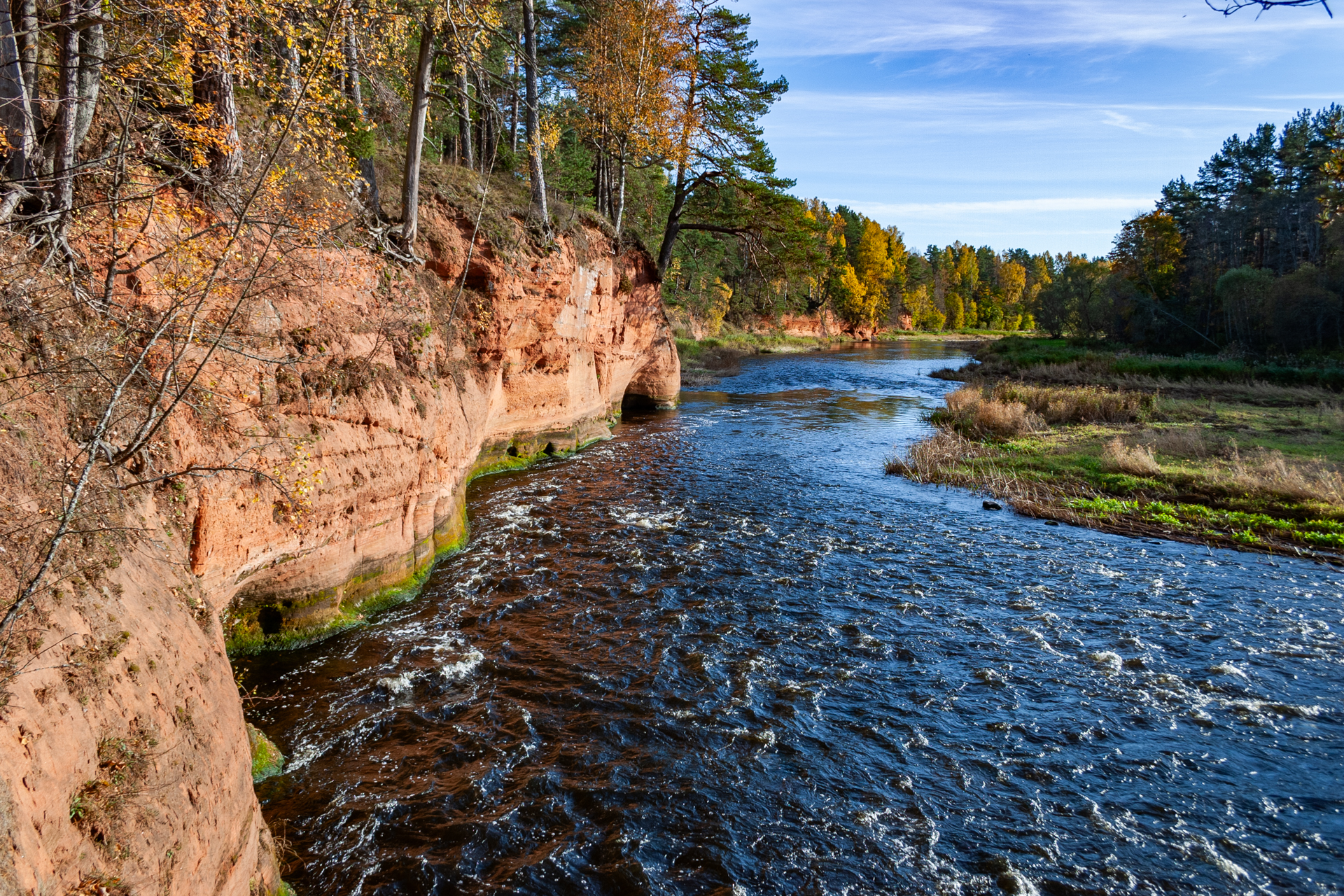
During the hike, led by nature education specialists, you will be able to get to know the specially protected nature area “Salacas ieleja” (Salaca Valley), an important site for the protection of many protected habitats, including sandstone outcrops, caves, slope forests, spring fens and river rapids.
The route will wind along the left bank of the Salaca to view the right bank from the ten-metre-high Pietrags cliffs. The Pietrags cliffs stretch for 400 metres and are the largest cliffs on the lower Salaca, one of the most scenic sandstone outcrops in the Salaca valley. The path will then continue along the Norēnupe, also called the Noriņa.
“Pietrags and the Noriņupe are outstanding testimonies to the forces of nature – ten-metre-high cliffs, sandstone formations, and oaks and birches that have reached the size of giant trees. It is worth seeing with your own eyes and enjoying the autumn atmosphere in nature,” says Linda Kauliņa, coordinator of the North Vidzeme Biosphere Reserve.
The hike starts at 11:00 at the Iron Bridge over the Salaca (Ainaži parish, Limbaži municipality). Total length: six kilometres. Registration is required on www.tiekamiesdaba.lv under “Notikumu kalendārs” (Events calendar) for this event.
What do you need to know before going on such an activity – is any special equipment needed?
In practical terms, it is like any other hike – you need comfortable clothes and suitable footwear. But it is even more important to be a knowledgeable nature lover, so as not to harm nature.
It is important to remember that you are a guest in nature. There are a few universal recommendations to follow. For example, if you need to cross a river, it is best to do so where larger trees have fallen into the river, or to use beaver dams as bridges. Pay particular attention to places where mussel shells can be seen on the bottom of the watercourse: you must not cross the river there, as the mussels could be trampled and the stirred-up sediment would also harm them. If there is a bird’s nest or an animal’s den on the riverbank, go around it so as not to disturb its inhabitants. And, of course, take home whatever you bring into nature!